A brother asked an old man, ‘How can I be saved?’ The latter took off his habit, girded his loins and raised his hands to heaven, saying, ‘So should the monk be: denuded of all the things of this world, and crucified. In the contest, the athlete fights with his fists; in his thoughts, the monk stands, his arms stretched out in the form of a cross to heaven, calling on God. The athlete stands naked when fighting in a contest; the monk stands naked and stripped of all things, anointed with oil and taught by his master how to fight. So God leads us to victory.’
The Wisdom of the Desert Fathers, #11
Category: Asceticism
living sacrifice
I beseech you therefore, brethren, by the mercies of God, that ye present your bodies a living sacrifice, holy, acceptable unto God, which is your reasonable service.
Romans 12:1
fasting
What It Means to Fast.
To fast is to grieve over one’s sins.
Kierkegaard, Journals 4
And one does it best by anointing one’s head and washing one’s
face, so one doesn’t seem to be fasting.
an absurd hermit
Just as Camus advocated “revolt” in the face of metaphysical absurdity, contemporary thinkers and activists often call for micro-resistance:
- Acting ethically even when systems seem rigged.
- Organizing locally rather than waiting for top-down change.
- Telling the truth even when it appears futile.
Absurdism thus informs a tragic ethics: not heroism with guarantees, but action without illusions. It’s the courage to do what’s right even when success is unlikely. … The absurd hero does not find meaning in the outcome but in the act itself—whether it’s fighting for justice, creating art, or simply getting out of bed each day.
Smith, KJ. A Brief History of Absurdism
Acts 18
And Paul after this tarried there yet a good while, and then took his leave of the brethren, and sailed thence into Syria, and with him Priscilla and Aquila; having shorn his head in Cenchrea: for he had a vow.
Acts 18:18
Hair cut and vow? What does this mean?
John 12
He that loveth his life shall lose it; and he that hateth his life in this world shall keep it unto life eternal. If any man serve me, let him follow me; and where I am, there shall also my servant be: if any man serve me, him will my Father honour.
John 12:25, 26
… by me
Jesus saith unto him, I am the way, the truth, and the life: no man cometh unto the Father, but by me.
John 14:6
I often meditate on the first half but this morning I am drawn to “no man cometh … but by me”. Jesus is the only way! (And the full revelation of God.)
oratory of the transfiguration
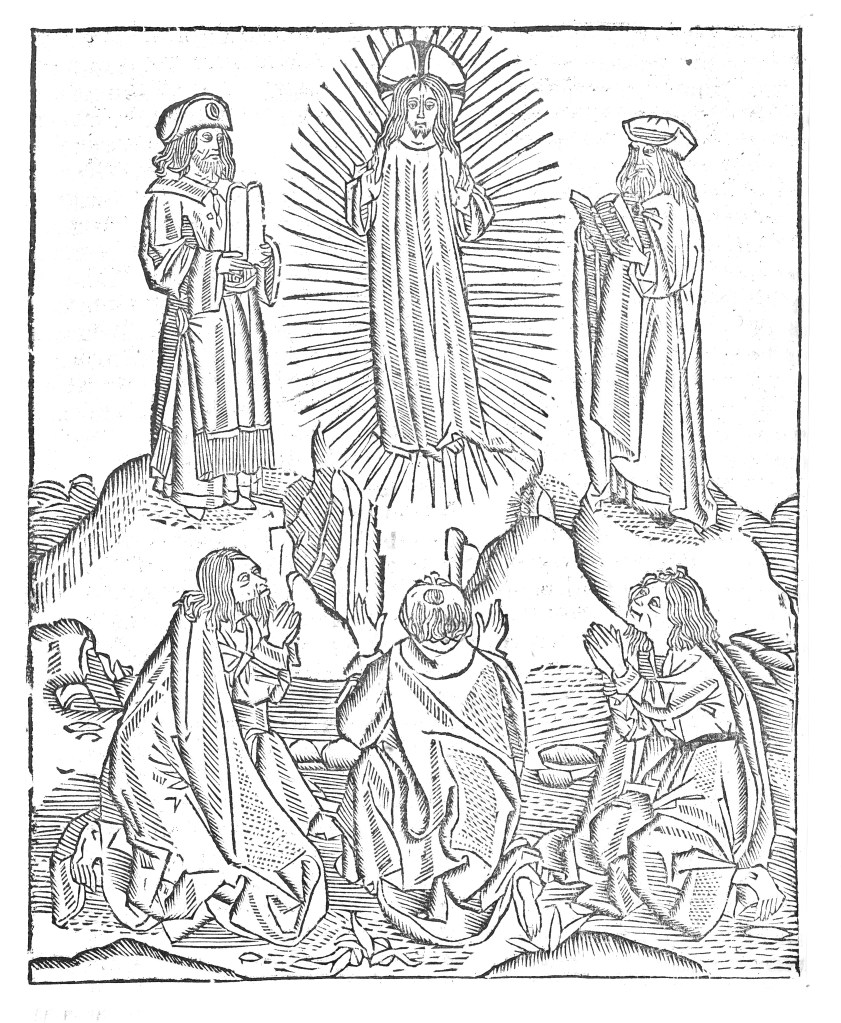
And after six days Jesus taketh Peter, James, and John his brother, and bringeth them up into an high mountain apart, and was transfigured before them: and his face did shine as the sun, and his raiment was white as the light. And, behold, there appeared unto them Moses and Elias talking with him. Then answered Peter, and said unto Jesus, Lord, it is good for us to be here: if thou wilt, let us make here three tabernacles; one for thee, and one for Moses, and one for Elias. While he yet spake, behold, a bright cloud overshadowed them: and behold a voice out of the cloud, which said, This is my beloved Son, in whom I am well pleased; hear ye him. And when the disciples heard it, they fell on their face, and were sore afraid. And Jesus came and touched them, and said, Arise, and be not afraid. And when they had lifted up their eyes, they saw no man, save Jesus only.
Matthew 17:1-8
“Jesus only” – that is my desire!
Follow on Facebook: Oratory of the Transfiguration
sect or faithful remnants?
This older documentary is really eye opening (for me) on some issues. Watch and enjoy!
BCP and fasting?
I asked this on FB so …
For those in the know (you know who you are): with the revision of the Prayer Book, what is the canonical standing of the “Tables and Rules for the Feasts and Fasts through the whole Year”?
Is an Anglican to keep these fasts?
There is an ascetic system enshrined in BCP (1662) – a discipleship way. But I have never heard anyone speak of it?
The Religious Societies of the seventeenth century offer most practical and important witness. Associated with Anthony Horneck’s ministry at the Savoy Chapel, London, and later with William Beveridge and Robert Nelson, these societies arose as an attempt – and a successful one – to practise the full teaching of the Church as enshrined in the Book of Common Prayer. The initial influence of these societies, these “Faithful Remnants”, was enormous, and history supports their sanity and zeal. The recitation of the daily Office was central to their activity, a priest-director was an essential part of the system, while works of charity towards the poor were a natural outcome. It is significant that their demise came when extraneous interests in politics and sociology overbalance the original Godward intention. For most of our modern parochial organizations, the writing on the wall could hardly be plainer.
English Spirituality

