For example, when asked, “What did Jesus do to save you?” many Christians will immediately answer something like, “He died on the Cross to pay the price for my sins.” Yet the idea that God the Father required repayment from Jesus to satisfy humanity’s debt to God has not always been a Christian teaching. It is also not the only way to think about salvation in Jesus Christ. This atonement model developed in the West on a trajectory from the teachings of Anselm, an eleventh-century Roman Catholic bishop. The so-called satisfaction model of Anselm has not held sway in the Orthodox Church for several reasons, including that Orthodox theology is not transactional in nature (e.g., there are not even “vows” or promises in the Orthodox Sacrament of Holy Matrimony). The main reason, however, is that a sharp and narrow focus on the Cross obscures all that the Son of God has accomplished for His fallen creation. In an Orthodox worldview, the full scope of what Jesus Christ has done must also include His Incarnation, His Resurrection, and even Pentecost.
A Basic Guide to Eastern Orthodox Theology, 29
Category: Orthodox
beards etc
[W]earing a beard in Orthodoxy can and should be interpreted as an outward sign of an inward belief. The Bible makes a strong case that growing a beard is an honor for a man and glory to God. … What is it about a man’s face that would cause him to reflect on who and what he is and what is required of him? In short, if he wore a beard in compliance with the holiness code, he would immediately be reminded of his obedience to God and his ways. Modern times reflect something similar.
Ask An Eastern Orthodox Christian: On Beards
To shave or not to shave, that is the question. I have a beard because I am lazy and really dislike shaving.
Yet the above makes the point that the outward sign is a reminder for the individual. This is a great starting point for everything – clothing, religious symbols, etc. These are a reminder for me and not a religious “look at me”. Or, as Soren Kierkegaard says,
[The individual] is a stranger in the world of the finite, but does not define his difference from worldliness by an alien mode of dress (a contradiction, since it would define him as worldly); he is incognito, but his incognito consists precisely in looking just like everyone else.
Concluding Unscientific Postscript (Cambridge Texts in the History of Philosophy), 345
Ok, not incognito with a long white beard but nothing about me screams heretic!
nice picture
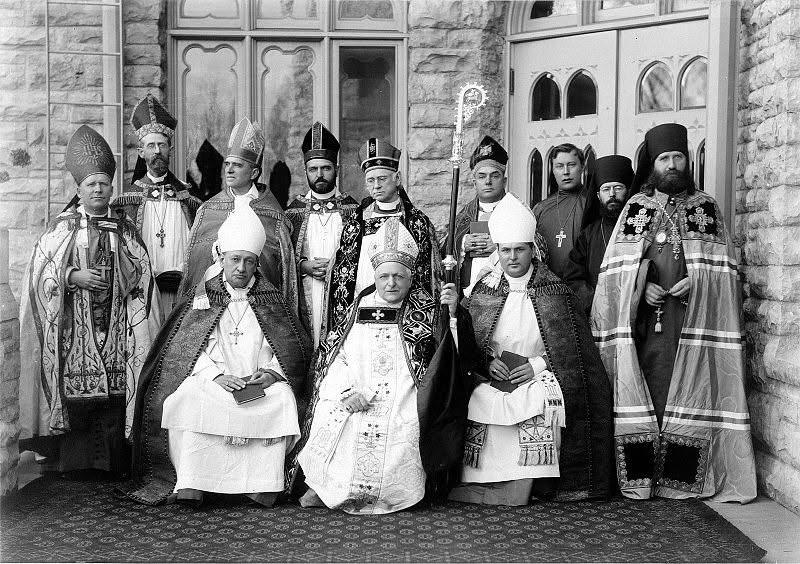
The consecration of Reginald Heber Weller as an Anglican bishop at the Cathedral of St. Paul the Apostle in the Protestant Episcopal Diocese of Fond du Lac.
Seated (left to right):
The Rt. Rev. Isaac Lea Nicholson, Episcopal Bishop of Milwaukee;
Rt. Rev. Charles Chapman Grafton, Episcopal Bishop of Fond du Lac;
Rt. Rev. Charles P. Anderson, Episcopal Bishop Coadjutor of Chicago.
Standing (left to right):
Rt. Rev. Anthony Kozłowski of the Polish National Catholic Church;
Rt. Rev. G. M. Williams, Episcopal Bishop of Marquette;
Rt. Rev. Reginald Weller,
Rt. Rev. Joseph M. Francis, Episcopal Bishop of Indianapolis,
Rt. Rev. William E. McLaren, Episcopal Bishop of Chicago;
Rt. Rev. Arthur L. Williams, Episcopal Bishop Coadjutor of Nebraska;
St. John Kochurov, Russian Orthodox protomartyr of the Bolshevik Revolution;
St. Sebastian (Dabovich),
St. Bishop Tikhon
interesting article
I found this article via Facebook and thought it was interesting. Before anyone says anything, I have no view of the innocence or guilt of the individual but rather like this as a picture of transfiguration:
The Redemption of Frank Atwood
Atwood’s story echoes the lives of the great repentant saints: the Apostle Paul, once a persecutor; St. Moses the Black, a violent brigand; or St. Dismas, the thief on the cross. His prison cell became a desert where he was able to work out his salvation with fear and trembling. His correspondence reveals a soul grappling earnestly with sin, bravely confronting his mortality, and seeking union with God. His sponsors and monastic community, including monks and nuns who witnessed his transfiguration, affirmed the authenticity of this change and swore to his innocence in the murder of poor Vicki Lynne. …
On the eve of his execution, June 7, 2022, Atwood was tonsured a monk, receiving the Great Schema. He was given a new name, Ephraim.
spiritual elders
Even though many of the elders were priests or monks, or both, being an elder was not a church office, but rather an informal ministry. Individual supplicants engaged with spiritual elders sometimes with, or sometimes without, the sanction of the institutional church. The reputation of an elder was established “from below” by ordinary believers and an elder’s disciples. Hence, within the Orthodox Church, eldership may be regarded as a more democratic, nonhierarchical form of religious authority, which, until now, has not received sufficient analysis. ….
Many of them had an uneasy relationship with the institutional church.
Spiritual Elders: Chrisma and Tradition in Russian Orthodoxy, 4-5

