black habit …

Canon XLII. Those who are called Eremites and are clothed in black robes, and with long hair go about cities and associate with the worldly both men and women and bring odium upon their profession—we decree that if they will receive the habit of other monks and wear their hair cut short, they may be shut up in a monastery and numbered among the brothers; but if they do not choose to do this, they are to be expelled from the cities and forced to live in the desert (ἐρήμους) from whence also they derive their name.

Council of Trullo (692)
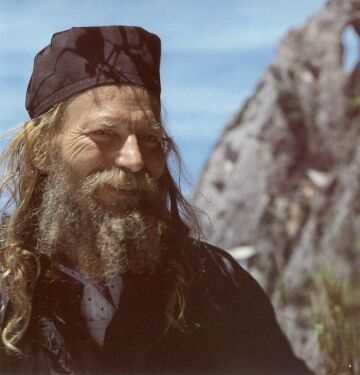
Hermits who were not monks have tended to keep both beards and hair uncut, although there have been and are exceptions. This has been based less on any specific prescription relating to hair rather than

  • following the tradition and practice of the earliest Hermits;
  • as a sign of lack of interest in or concern about physical appearance;
  • to minimise the need to pay attention to personal adornment through regular shaving and/or hair cutting;
  • as a reaction against worldly fashion (although this has raised some concerns at times when beards and/or long hair were the height of popular fashion!).
Hermits and Hair

prayer and fasting

Council of Chalcedon
Canon IV.

Let those who truly and sincerely lead the monastic life be counted worthy of becoming honour; but, forasmuch as certain persons using the pretext of monasticism bring confusion both upon the churches and into political affairs by going about promiscuously in the cities, and at the same time seeking to establish Monasteries for themselves; it is decreed that no one anywhere build or found a monastery or oratory contrary to the will of the bishop of the city; and that the monks in every city and district shall be subject to the bishop, and embrace a quiet course of life, and give themselves only to fasting and prayer, remaining permanently in the places in which they were set apart; and they shall meddle neither in ecclesiastical nor in secular affairs, nor leave their own monasteries to take part in such; unless, indeed, they should at any time through urgent necessity be appointed thereto by the bishop of the city. And no slave shall be received into any monastery to become a monk against the will of his master. And if any one shall transgress this our judgment, we have decreed that he shall be excommunicated, that the name of God be not blasphemed. But the bishop of the city must make the needful provision for the monasteries.

Henry R. Percival. The Seven Ecumenical Councils of the Undivided Church: their Canons and Dogmatic Decrees

Companion of New Skete

I am not a joiner! I did not join the “normal Anglo-Catholic” societies when I was a priest, nor any religious order as an oblate etc. But ….

It is intrinsic to ascetical theology to adapt itself to the contemporary situation, yet it can only evolve out of a living tradition with roots in the past.

English Spirituality, 13

I have been accepted as a Companion of the New Skete. And I am super excited. A connection to a living tradition while I remain within my own tradition. The beginning of a Prayer Book Ascetic.

salt to society

27. In the deserts of the old world, the first monks and nuns carried on the prophetic ministry of Israel in a renewed vigor. Thus, their lives bore witness to the essential Christian message before a civil and ecclesiastical world that often suffered from secularization, political intrigue, expediency, and a generally exaggerated and inhuman structuralism. They were thereby reminders to all that the Gospel was a way of life to be sought by all through the repentance that leads to the coming universal salvation.

28. Thus, monasticism must strive to keep this goal in mind, for it must be the salt of society; and for this reason if for no other, the monastery must be accessible to all, so that they may savor its life, its worship, and its message.

29. The fourth ecumenical Council of Chalcedon established canons for the inter-relationship of the monastery and the rest of the Church: nd the rest of the Church.

a. Though he may not interfere in the internal affairs of the monastery, the hierarch has the right to visitation, to impart the customary blessings when called for, and to ordain monks presented to him for orders. He should see to it that the integrity, purpose, and goal of the monastic life is preserved free of interference for the best interest the monks and nuns as well as the clergy and laity of the diocese in particular and the Church in general.

Monastic Typikon of the New Skete

… life of asceticism

The Questions and Answers.

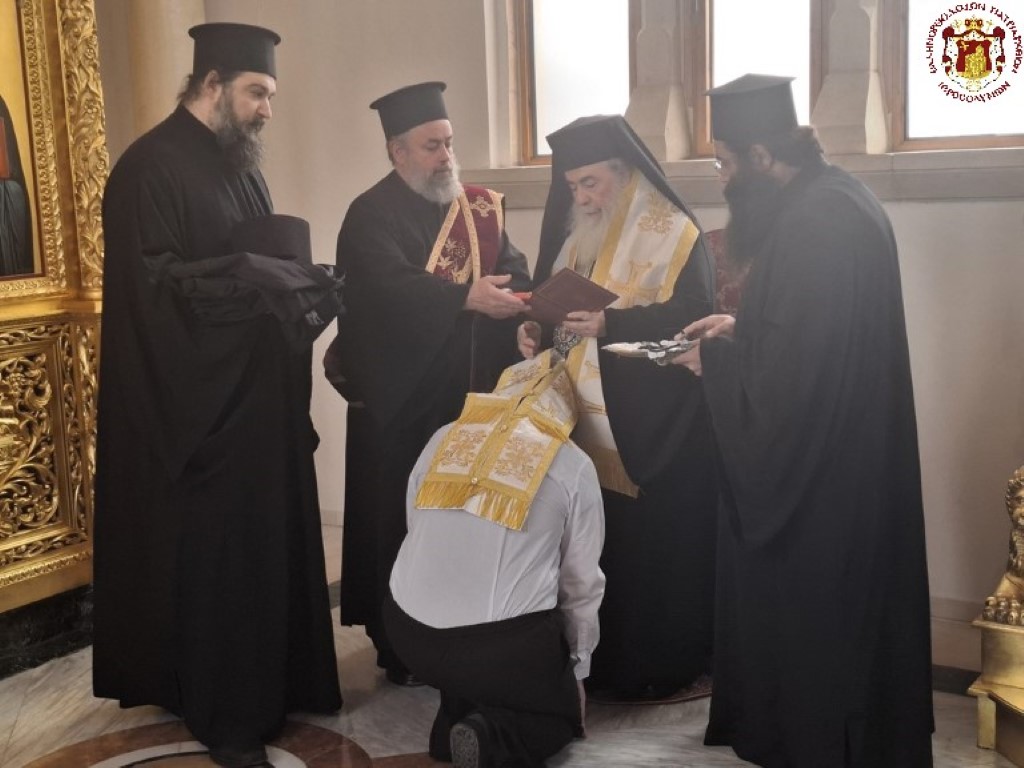
Question : Why hast thou come hither, Brother, falling down before the holy Altar, and before this holy Assembly ?
Answer: I am desirous of the life of asceticism, Reverend Father.

Question : Dost thou desire to be deserving of the Angelical Habit, and to be ranked in the company of those who are living as Monks?
Answer: Yes, God helping me, Reverend Father.

The Priest:
Truly a good work and a blessed hast thou chosen ; but only, if thou dost also accomplish it. For good works are wrought with labour, and achieved with pain.

Question: Of thine own willing mind comest thou unto the Lord?
Answer: Yes, God helping me, Reverend Father.

Question : Not by any necessity, or constraint?
Answer : No, Reverend Father.

… as at baptism

The Candidate at a Monastic Profession, a penitent like the Candidate for Baptism, comes as though to a second baptism. He is referred to in the Office itself as a Catechumen. He is unclothed in the Narthex, as though about to be baptized by immersion, and to signify that he is to put off the old man and put on the new. The Candidate takes Vows, similar to the baptismal vows of renunciation, faith, and obedience to the end of life. The Vows are taken, as at Baptism, in answer to formal and explicit questions. A new name is given, as at Baptism, which commonly has the same initial letter as the baptismal name; and the head is shorn, as at Baptism. The Habit given to the Monk or Nun at the Profession may be compared to the baptismal garments of the newly-baptized, consisting of the Chrisom-Robe, called in the Office of Baptism the Tunic of righteousness; the Girdle; and the Chrisom-Veil, known as the baptismal Cowl, or Cap. The Cross, the lighted candle, and the kiss correspond to those given at Baptism. And on the eighth day there follows the laying aside of the Cowl, after analogy of the laying aside of the baptismal robes.

In the Penitentiale of Theodore of Tarsus (a:b. 668-690) it is stated that the Monk covers his head with his Cowl for seven days, and on the seventh day the Abbot removes the head-covering, just as the Priest takes away the infant’s head-covering ; because, according to the opinion of the Fathers, the Monastic Profession is a second baptism, in which all sins are remitted as in baptism.

Monasticism in the Orthodox Church, 58-59

Theodore the Studite

Mortals, escape with me from a false world!
Christ calls. Away! Life be our voyage fair,
Safe riding o’er the surge of cares and lies!
One quest alone employs the lonely Monk,
How he may reach the Haven of true peace,
Where never comes the strain of breaking hearts.
O happy life, all music, free from sorrow!
Where is the prudent seeker of true gain
Will part with all the world and choose the Cross?