Love not the world, neither the things that are in the world. If any man love the world, the love of the Father is not in him. For all that is in the world, the lust of the flesh, and the lust of the eyes, and the pride of life, is not of the Father, but is of the world. And the world passeth away, and the lust thereof: but he that doeth the will of God abideth for ever.
Little children, it is the last time: and as ye have heard that antichrist shall come, even now are there many antichrists; whereby we know that it is the last time. They went out from us, but they were not of us; for if they had been of us, they would no doubt have continued with us: but they went out, that they might be made manifest that they were not all of us. But ye have an unction from the Holy One, and ye know all things.
I have not written unto you because ye know not the truth, but because ye know it, and that no lie is of the truth. Who is a liar but he that denieth that Jesus is the Christ? He is antichrist, that denieth the Father and the Son. Whosoever denieth the Son, the same hath not the Father: he that acknowledgeth the Son hath the Father also.
Let that therefore abide in you, which ye have heard from the beginning. If that which ye have heard from the beginning shall remain in you, ye also shall continue in the Son, and in the Father. And this is the promise that he hath promised us, even eternal life.
These things have I written unto you concerning them that seduce you. But the anointing which ye have received of him abideth in you, and ye need not that any man teach you: but as the same anointing teacheth you of all things, and is truth, and is no lie, and even as it hath taught you, ye shall abide in him.
And now, little children, abide in him; that, when he shall appear, we may have confidence, and not be ashamed before him at his coming. If ye know that he is righteous, ye know that every one that doeth righteousness is born of him.
15-29
Category: Asceticism
only the individual
When Jesus came into the coasts of Caesarea Philippi, he asked his disciples, saying, Whom do men say that I the Son of man am? And they said, Some say that thou art John the Baptist: some, Elias; and others, Jeremias, or one of the prophets. He saith unto them, But whom say ye that I am? And Simon Peter answered and said, Thou art the Christ, the Son of the living God. And Jesus answered and said unto him, Blessed art thou, Simon Barjona: for flesh and blood hath not revealed it unto thee, but my Father which is in heaven.
Matthew 16:13-17
From “whom do [others] say I am” to “whom say ye (pl)” to “Simon Peter answered”.
The interesting thing is that a single individual answers because the question is ultimately only answerable by an individual. Jesus makes this plain by using the singular when He answers Peter.
So my point: only you can answer the question, “Whom say ye that I am?” Not the past, nor the community that surrounds you, but only the single individual standing alone before God. It is the personal encounter with Jesus that asks for a response. And this response changes everything!
fasting?
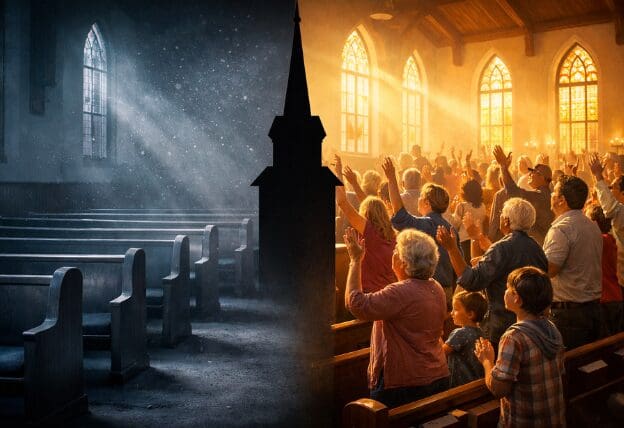
So I stumbled upon this article online: Your Church Is Dying Because You’re Afraid to Do These 6 Things. I was struck by “1. Enter a Time of Corporate Prayer and Fasting”. (And, tbh, the rest is pretty average.) So I was wondering, fasting?
I have also found an interesting article online: The Fall and Rise of Fasting in the British Reformations. It gives a historical English account from the time of the Reformation.
Third I was always wondered by the Book of Common Prayer (1662) includes Tables and Rules for the Feasts and Fasts through the whole Year. And what authority does this have for modern users of the BCP?
So, my question: what role should fasting play in the life of a modern follower of Jesus??
more about fasting
A religious Fast requires total abstinence, not only from all food (unless bodily weakness do manifestly disable from holding out till the Fast be ended, in which case somewhat may be taken, yet very sparingly, to support nature when ready to faint), but also from all worldly labour, discourses, and thoughts, and from all bodily delights (although at other times lawful), rich apparel, ornaments, and suchlike, during the Fast ; and much more from whatever is in the nature or use scandalous and offensive, as gaudish attire, lascivious habits and gestures, and other vanities of either sex ; which we recommend to all Ministers, in their places, diligently and zealously to reprove, as at other times, so especially at a Fast, without respect of persons, as there shall be occasion.
Before the public meeting each family and person apart are privately to use all religious care to prepare their hearts to such a solemn work, and to be early at the Congregation. So large a portion of the day as conveniently may be is to be spent in Public Reading and Preaching of the Word, with Singing of Psalms fit to quicken affections suitable to such a duty: but especially in Prayer, to this or the like effect.
Book of Common Order
St Elisabeth the New Martyr
deny yourself and transfiguration
Saying, The Son of man must suffer many things, and be rejected of the elders and chief priests and scribes, and be slain, and be raised the third day. And he said to them all, If any man will come after me, let him deny himself, and take up his cross daily, and follow me. For whosoever will save his life shall lose it: but whosoever will lose his life for my sake, the same shall save it. For what is a man advantaged, if he gain the whole world, and lose himself, or be cast away? For whosoever shall be ashamed of me and of my words, of him shall the Son of man be ashamed, when he shall come in his own glory, and in his Father’s, and of the holy angels. But I tell you of a truth, there be some standing here, which shall not taste of death, till they see the kingdom of God.
Luke 9:22-27
Note the similarity between the above and Matthew 16:24-28 and Mark 8:34-38. And each of these passages are followed by the Transfiguration account (Matthew 17:1-8 and Mark 9:2-8)
So ….
Part of Transformation (μεταμορφόομαι), the aim to be like Jesus, is “deny yourself and take up your cross”. And it is all about “follow me”, which is about losing my life for HIS sake, the same shall save it.
“I am”
Jesus therefore, knowing all things that should come upon him, went forth, and said unto them, Whom seek ye? They answered him, Jesus of Nazareth. Jesus saith unto them, I am he. And Judas also, which betrayed him, stood with them. As soon then as he had said unto them, I am he, they went backward, and fell to the ground.
John 18:4-6 KJV
Further to Truth and Jesus …
Thought 3: The reaction (fell to the ground) is unexpected. Why? When Jesus says “I am”, He connects Himself to revelation of the Divine Name (Exodus 3:15). He is the Divine Truth revealed to Moses in the burning bush. He is Truth Incarnate.
Thought 4:
Ascetical theology makes the bold and exciting assumption that every truth flowing from the Incarnation, from the entrance of God into the human world as man, must have its practical lesson. If theology is incarnational, then it must be pastoral.
English Spirituality, 21
not in essence but in intensity
Monasticism is the most authentic form of Christian discipleship. As Basil sees it, if we would let the Lord’s grace have its way with us, if we would follow our baptism to its end and keep all the commandments, we would end up in the monastic life. Indeed, Basil’s word (eisagomenoi) for candidates seeking to enter the monastic community is also the word for catechumens, indicating a “link between the ascetic life and baptism.” Basil’s “monks”—as they would later be called and as we call them—“were simply,” Robert Taft writes, “Christians taking the whole business seriously.” The monastic life, then, differs from the life of ordinary discipleship not in essence but in intensity. But what does this most intense Christian life look like in Basil’s thought and practice?
One of the most fascinating features of the fourth-century church is that we get to observe monasticism in its various stages of development, from devoted and pious family to highly organized monastery, from informal household virginity to ritually consecrated virginity.
Stephen Hildebrand, Basil of Caesarea, 125

