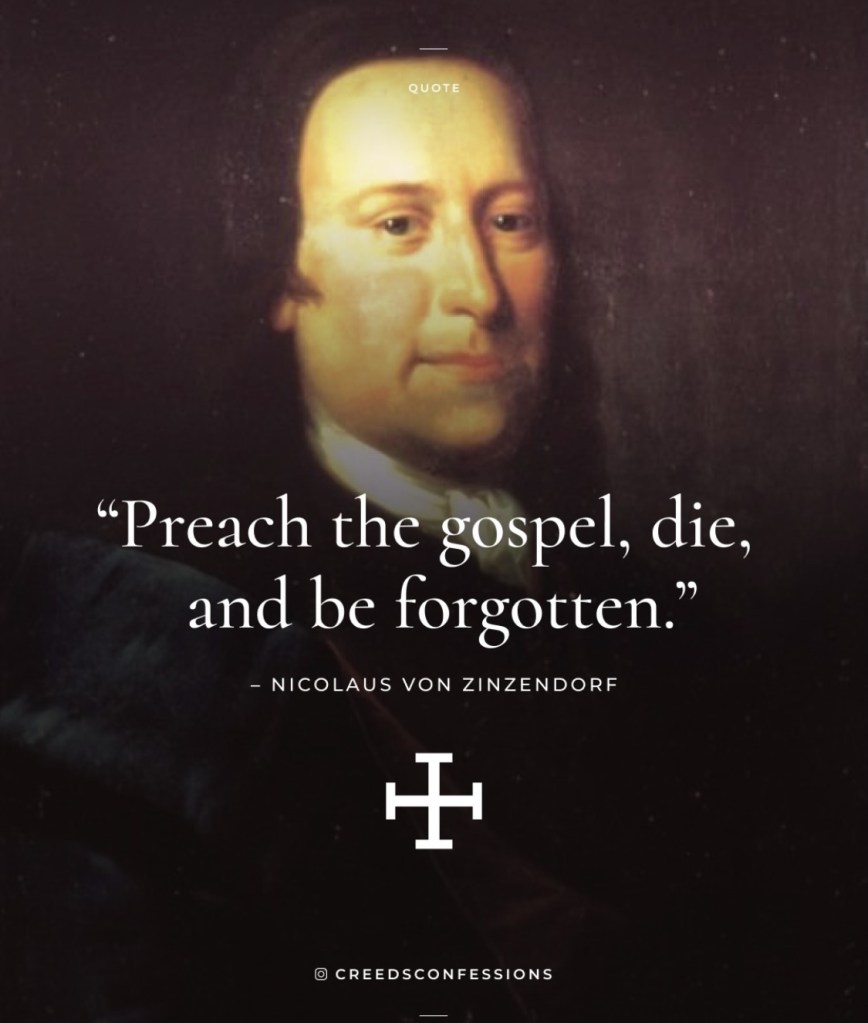
Day 658 – to be forgotten

I am a fan of reader-response in literary theory. So when I saw this quote, it made me think:

I am not sure if the quote is actually from Zinzendorf. Yet, for me, the last part spoke to me. I am willing to be forgotten!? Or, another way, “you have died, and your life is hidden with Christ in God” (Colossians 3:3).

It is one thing to speak about “hiddenness” and think about the anonymity of the solitary life. But am I prepared for the consequences?

No easy answers. But a desire for Jesus alone! Anyway …

Day 656 – “transubstantiation”

One of the earliest pieces has this to say about reading:

It is, namely, the transubstantiation of experience; it is an unshakable certainty in oneself won from all experience, whether this has oriented itself only in all worldly relationships (a purely human standpoint, Stoicism, for example), by which means it keeps itself from contact with a deeper experience — or whether in its heavenward direction (the religious) it has found therein the centre as much for its heavenly as its earthly existence, has won the true Christian conviction “that neither death, nor life, nor angels, nor principalities, nor powers, nor the present, nor the future, nor height, nor depth, nor any other creation will be able to separate us from the love of God in Christ Jesus our Lord.”

Kierkegaard

Reading is much more than information but an experience that changes me. It is not something to do while I am bored but a choice for change.

Anyway …

Bookshop with tea

Daily writing prompt
If you were going to open up a shop, what would you sell?

I would open a bookshop which also serves various types of tea.

The books would be a range but, maybe, more existentialist. Maybe some Kierkegaard, Kafka, and Camus? The tea would be Russian! Or some Earl Gray. Leafs only. There would be afternoons for people to discuss ideas – any idea! Tea, books, and real conversation.

Day 652 – ‘… economy of the Holy Ghost’

The contribution which stands out, however, as one reads the debate a century later, came from Charles Grafton, Bishop of Fond du Lac in the USA, the only bishop present who had been a member of a community. He made three important points. First, he believed Religious Life was a vocation and should be treated as such. Second, it did not belong, as priesthood did, to the corporate life of the Church, but instead belonged ‘to the economy of the Holy Ghost’. Obedience to a Religious superior was a voluntary action of love, not the result of the legislative action of the Church. Unlike ‘the fixity of ministerial orders’ then, he believed the work of the Holy Ghost in the call of Religious Life manifested itself in a variety of different forms. Bishops had to trust this call to have a corrective power in itself. Third, he reminded the Conference that in Religious, bishops were dealing with ‘special devotional temperaments’ that could be ‘personally emotional’ about small matters of worship. A high-handed approach would not therefore be advisable. He went on to echo the arguments put forward in Father Puller’s paper, and concluded by suggesting bishops should regulate communities only in relation to property, financial donations and insisting on communities’ having sound government.

Petà Dunstan, Bishops and Religious 1897-1914

words and silence

Daily writing prompt
What are you curious about?

My day is largely in silence. Yes, I listen to music and the radio (for the news). But there are long periods of silence. (I also read books etc but in silence.)

One thing that has made me curious about this context is how we see language. Or, how metaphor and language interact. Augustine wrote about language before he wrote about Christianity. But we seem to think that we can simply march past the problem and declare absolutely what is (and what is not) a relationship with God.

I have no answers and maybe there isn’t one. But I am curious!

rise

Daily writing prompt
Describe one habit that brings you joy.

This may sound a little strange – and, well, it is. I like to get up early. I mean really early. Currently, my alarm is set for 4:30 am. Often I am awake before it.

Why so early? I have found that it offers me time for mental prayer. And it provides me silence. I have a cup of tea in darkness without the possibility of interruption. I say Morning Prayer at 5:30 am and listen to the 6:00 am ABC News. And then my day starts!

It is something to which I look forward. It is a habit that brings me much joy.

Day 635 – “abstraction”

One of my favourite Kierkegaard quotes relates to levelling and the power of abstraction:

… leveling is an abstract power and is abstraction’s victory over individuals.

Two Ages: The Age of Revolution and the Present Age A Literary Review, 84

The parish is in a period of transition – moving to welcoming a new vicar. I struggle with change so it is a time of anxiety. And my brain likes to play the “what if” game.

In that context, I was thinking about how I would explain my life. I tried, with little success, to write a rule in the form of a letter like the anchorite guidance literature. Also, I tried to collect Scripture verses to illustrate various precedents. One issue surrounding the solitary life is its very nature: an individual living an individual life. Yes, there is a historical precedent. But, like Lessing, there is an “ugly ditch” between the precedent and the lived experience.

So the first lesson is that maybe I simply need to live. My greatest battle is to surrender the desire (the motivation for my actions) to be accepted and loved. If I live for Jesus alone, I should seek all good things from Him alone! And then, restored and refreshed, I can love my neighbour without seeking something in return. (I am some distance away.)

Is any attempt to define, to abstract this life, really a desire to be admired as a spiritual hero?

Second lesson: my lived experience is beyond abstraction. Perhaps the whole point of the solitary life is a life dedicated to Jesus without further abstraction? Maybe real life is lived in the space beyond definition? A personal relationship is as individual as the persons involved. While there may be common elements, these do not define the relationship.

Just some random thoughts! Anyway …