I found this video and thought I would share it. I feel a kinship with St Macarius. Enjoy!
header image
I thought I would update the header image to reflect more of where I am at. So here it is:
layperson?
Yesterday, during “leadership prayers” before church, I had this strange inside: I like being part of a community of Christians within the Anglican tradition. I had this very strong sense that this was a new beginning for us as a community and for me as an individual. I have been struggling with a couple of issues and, as always, it has affected my sense of balance.
I have been thinking about what it means to be a layperson. And, in my case, a layperson with a theological degree. So a person who has the same academic qualification as a priest but has no desire to become clergy. I will add, a very happy Anglican! Experience has taught me that I do not have the gifts to run a parish or to be involved in the larger denominational context. I am somewhat of a free spirit and like my own agenda.
I have no desire to lead a parish (what a disaster that would be) and I do not want to celebrate the divine mysteries. Other people do that much better than I could ever do. I am happy to use my gifts within the liturgy as a layperson – serving or being Master of Ceremonies, and sacristan. In my current context, it means helping with the technology on a Sunday and setting up the altar before our service.
For my own mental health, I need to be in “the moment”. That means being what I am right now and not looking forward to a possible self that depends on others. And right now I am a “happy layperson” who sometimes teaches and sometimes helps in the parish. I like the freedom of being “without authority” (like SK!). I like that I am answerable to my vicar for what I teach and what I do.
I like the freedom of being an Anglican – the unity within diversity that means I can be “somewhat Catholic” within an emerging parish. A context where doctrine is a witness but not as important as Jesus. I want to be part of a context where the sign of the cross is as familiar as hands raised in praise. Individuals gathering around Jesus!
So a somewhat weird start to the week!!!
as long as I know how to love
I heard this song on the way home from church. Yes, I have heard it before but the lyrics really struck me today. A witness to the truth and an echo of what has been going on inside me.
“As long as I know how to love I know I’ll stay alive”!!!!
witnesses to Jesus
I have been continuing to read The Freedom to Become a Christian: A Kierkegaardian Account of Human Transformation in Relationship with God. (I had a very pleasant hour on the beach yesterday reading and watching the waves.)
I just wanted to share two quotes that really struck me:
When Christian conceptions or propositions become the object of the Christian faith (for example, in the form of Christian doctrine), ‘Christianity’ becomes a plaything for intellectual pursuits, cultural sensibilities and political agendas. This is not, of course, to deny that Christian concepts and propositions serve a purpose. Their primary purpose, however, is to serve as a witness to God: to provide us with teaching that helps us to talk about, understand and know both who God is and who we are before God. But, for Kierkegaard, they are not to take centre stage.
The Freedom to Become a Christian, 4.
I was struck by the idea that doctrine etc are witnesses. And that these provide a framework for us to speak about God.
The conclusion that this work seeks to draw is that, for Kierkegaard, Christian belief and understanding are subordinate to a person’s relationship with God. They do not constitute the relationship itself. They are nothing more than a witness to and expression of the fact that God actively relates to us in history.
This is the main aim of the book. And I think this is a really important point to remember: it is all about a relationship. As the author further explains it is about a choice for the Christian life, it is not about conclusions but rather a resolution. (The last part is me!)
receiving
I have been thinking (or should I say “reading about”) posture in prayer. In the mystical tradition is there is an emphases on standing for prayer. I read an article about Julian of Norwich that made the point of “receiving in prayer” with hands open.
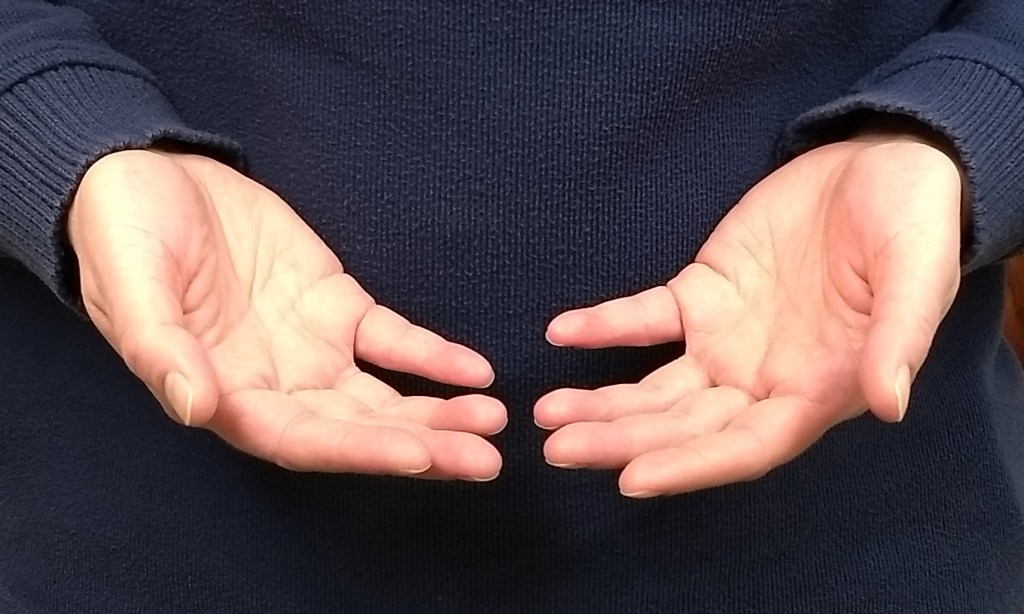
I admit that I am often more interested in telling God what to do than receiving anything from Him in my own prayer life. Receive, yes, but after I have told God what I want and need. I really like the above gesture during prayer – open to receiving from God. Being open and empty before the Throne of Grace. Simply allowing myself to be in the presence of Jesus.
I have also watched a couple of YouTube videos on Mount Athos – the self-governing monastic island. I was struck by how the monks simply pray while they work. They recite the Jesus Prayer or a single word. Not long complicated requests of God but simply begging for His mercy.
So I would like to emulate openness and simplicity in my prayer life.
who would want to be a philosopher?
Reading this, who would want to be a philosopher?
As a side-note: Søren Kierkegaard died in 1855 possibly from complications from a fall from a tree in his youth. Or, as I like to think, of a broken heart!
avatar
I have been playing round with avataaars generator. And here is one of the final avatars:

Spotify Greenroom
So, I read about Spotify Greenroom this morning. Yes, it is Clubhouse from Spotify and at the moment I think it is limited – or it might be me! But this would be a great platform for discipleship!!! That can be recorded into a podcast for further use. Anyway, I am excited!
Follow me, @onesolitaryanglican, and I will follow back.
birth of John the Baptist
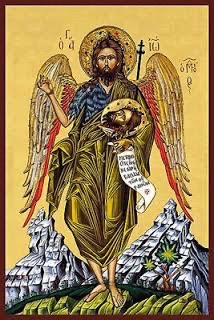
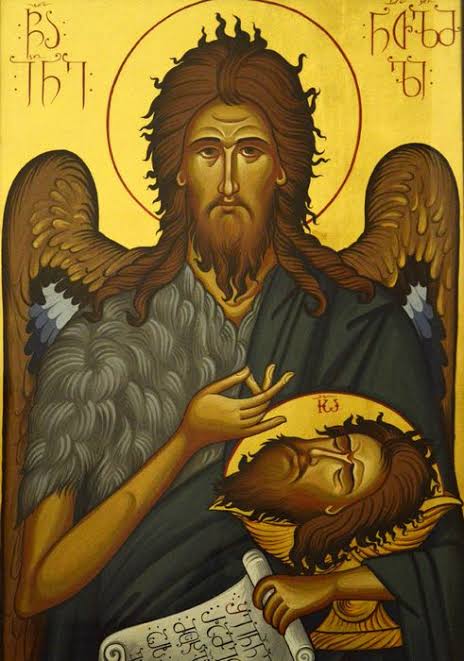
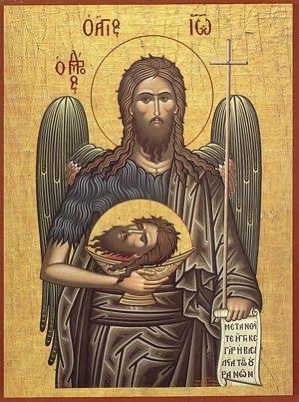
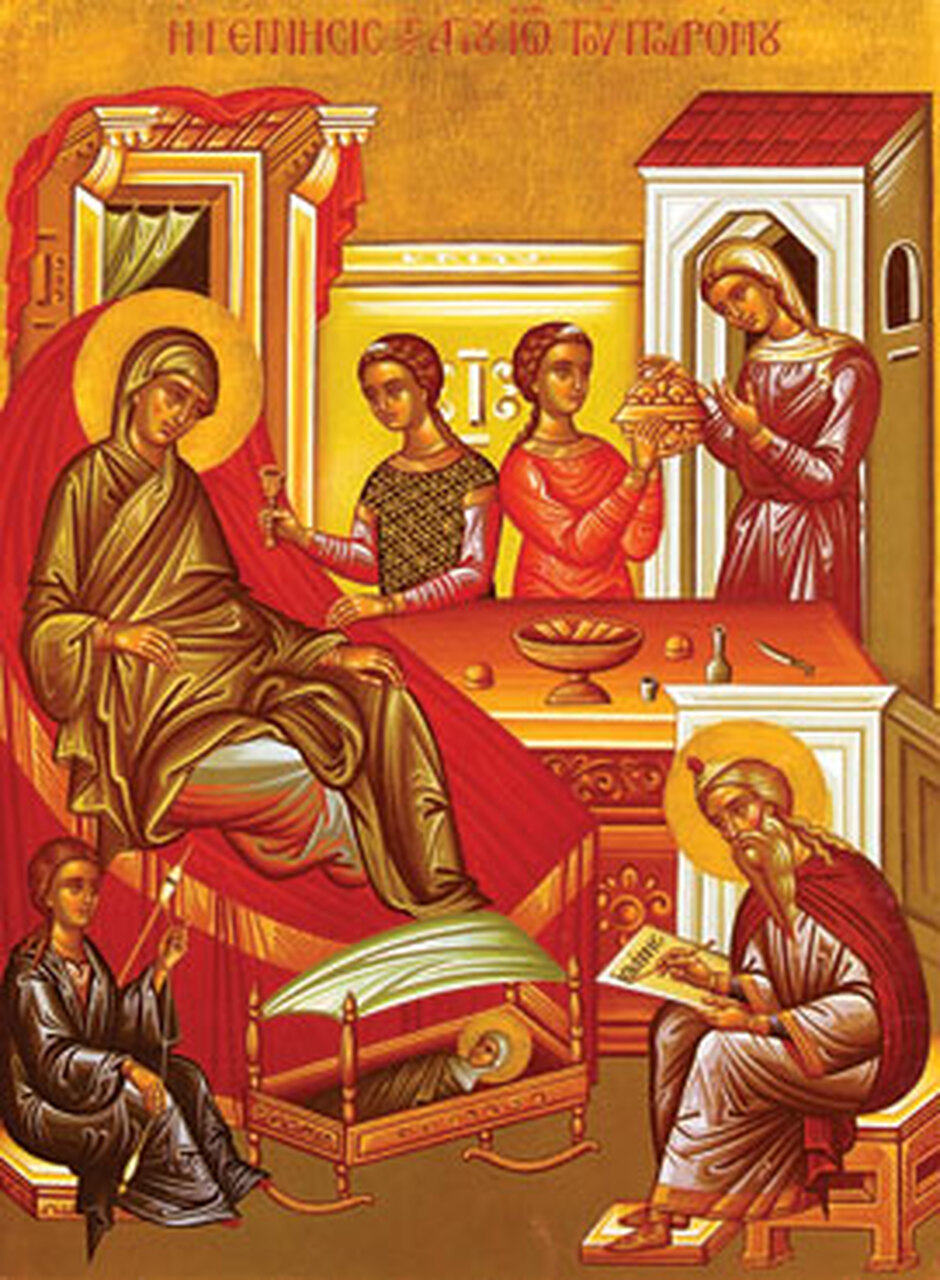
Today is the festival of the Birth (Nativity) of St John the Baptist. Even APBA has a festival office for the occasion. It is, as a personal note, the liturgical date that I started by journey within the Roman Catholic Church which came to an end almost 12 years later. There is something about that but that is for another post.
John is a hermit-like figure. In iconography, he often has the wings of a messenger and he carries his own decapitated head, a sign of his martyrdom at the hands of Herod. John’s task is to proclaim Jesus knowing that, like Jesus, that will cost his life.
The New Testament illustrates this connection. Mark’s gospel starts with John but quickly moves to Jesus. But there is bridge between the two ministries.
Now after John was arrested, Jesus came to Galilee, proclaiming the good news of God, and saying, “The time is fulfilled, and the kingdom of God has come near; repent, and believe in the good news.”
Mark 1:14-15
The verb which is used for John’s arrest is the same verb that is used during Jesus’ passion. I think Mark wants us to draw the connection: John shares in Jesus’ cross with his own life. From the outset, he is a martyr – a witness of Jesus in his life. For John that becomes a truth – he is killed for Jesus. But there is a vital connection to my life:
As Jesus passed along the Sea of Galilee, he saw Simon and his brother Andrew casting a net into the sea—for they were fishermen. And Jesus said to them, “Follow me and I will make you fish for people.” And immediately they left their nets and followed him. As he went a little farther, he saw James son of Zebedee and his brother John, who were in their boat mending the nets. Immediately he called them; and they left their father Zebedee in the boat with the hired men, and followed him.
Mark 1:16-20
The previous passage is followed by the calling of the first disciples in Mark’s gospel. It is interesting that John’s call to martyrdom – call to be a witness in his life – is followed by Jesus saying, “Follow me”. The call of faith is to face Jesus’ cross and my own cross. The call is one to sacrificial living as a witness of Jesus.
So blessed feast to all!!!

