I adore you, Lord Jesus Christ, hanging upon the Cross, and bearing on your head a crown of thorns: I beseech you, Lord Jesus Christ, that your cross may free me from the avenging Angel.
I adore you, Lord Jesus Christ, wounded upon the cross, drinking vinegar and gall: I beseech you, Lord Jesus Christ, that your wounds may be my remedy.
I adore you Lord Jesus, placed in the tomb, laid in myrrh and spices: I beseech you, Lord Jesus Christ, that your death may be my life.
I adore you, Lord Jesus Christ, descending into hell, liberating the captives: I beseech you, never let me enter there.
I adore you, Lord Jesus Christ, rising from the dead, ascending into heaven and sitting on the right hand of the Father: have mercy on me, I beseech you.
O Lord Jesus Christ, the good shepherd, preserve the righteous, make righteous the sinners, have mercy on all the faithful: and be gracious to me, a sinner.
O Lord Jesus Christ, I ask you for the sake of that most bitter suffering which you bore for my sake upon the cross, and above all when your most noble soul left your most holy body: have mercy on my soul at its departing. Amen. We adore you O Christ and we bless you, Because by your holy cross you have redeemed the world. Lord hear my prayer. And let my cry come to you.
We adore you O Christ and we bless you, Because by your holy cross you have redeemed the world. Lord hear my prayer. And let my cry come to you.
The prayer:
O most kindly Lord Jesus Christ: turn upon me, a miserable sinner, those eyes of mercy with which you beheld Peter in [Caiaphas’] court, and Mary Magdalene at the banquet, and the thief on the gibbet of the cross: and grant that with blessed Peter I may worthily lament my sins, with Mary Magdalene may perfectly serve you, and with the thief may behold you eternally in heaven. Who live and reign with the Father and the Holy Spirit, God for ever and ever.
Duffy, Eamon. The Stripping of the Altars: Traditional Religion in England, 1400-1580 (pp. 325-326). Yale University Press.
Category: Prayer
… traditional devotions
I was reading about the traditional devotional life of anchorites in Medival England. These anchorites followed the fashion of the day, which was dominated by affective piety focusing on the humanity of Jesus. So the major focus was the Passion of Jesus.
Besides the 15 Oes, there were prayers to “The Five Wounds of Christ”, “The Seven Wounds of Mary”, or the “Seven Prayers of St Gregory” centring on the Passion of Jesus. There were also liturgical feasts dedicated to the Prayer in the Garden, the Five Wounds of Jesus, the Winding Sheet (burial shroud), and the Precious Blood.
As an aside, The Gregory Prayer Book has a number of these prayers and devotions. An interesting and useful aid to my prayers. There is also a Book of Hours available that gives some insight into English devotional life.
I wonder what happened to all these devotions?
Collect for Richard Rolle
O God, who by the example of the most holy hermit Richard taught us to despise the earthly and to seek with a sincere heart the heavenly: grant to us, [through his merits and prayers,] that we may imitate him faithfully and drink with him in the eternal bliss. Through Jesus Christ our Lord.
The above is a translation from The Officium and Miracula of Richard Rolle of Hampole.
silence
As my prayer become more attentive and inward
Kierkegaard
I had less and less to say.
I finally became completely silent.
I started to listen
– which is even further removed from speaking.
I first thought that praying entailed speaking.
I then learnt that praying is hearing,
not merely being silent.
This is how it is.
To pray does not mean to listen to oneself speaking,
Prayer involves becoming silent,
And being silent,
And waiting until God is heard.
choir stall
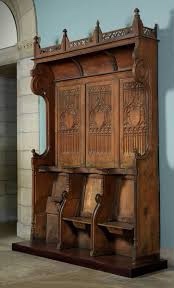
I would like a stall like that!!
things eternal
O God, the protector of all who trust in you,
Common Worship
without whom nothing is strong, nothing is holy:
increase and multiply upon us your mercy;
that with you as our ruler and guide
we may so pass through things temporal
that we lose not our hold on things eternal;
grant this, heavenly Father,
for our Lord Jesus Christ’s sake,
who is alive and reigns with you,
in the unity of the Holy Spirit,
one God, now and for ever.
I wanted to share the above collect from Common Worship – the collect for this last week. Every day I have been struck by the line: “we may so pass through things temporal that we lose not our hold on things eternal“. It is the struggle of all followers of Jesus: to live in this world without being part of this world.
I think theologians have tried to bring balance to this paradox in various ways. But in the end both are gifts from God: the temporal and the eternal. The call is to see the eternal in the temporal and thereby bring the temporal into the eternal.
I like Common Worship more everyday.
Common Worship: Daily Prayer

I have been using the Church of England’s Common Worship: Daily Prayer for nearly a year. I like the wording and the way everything is organised. I like that there are antiphons and Psalm Prayers.
AND today I found that there is an online site with Morning, Evening, Prayer During the Day, and Night Prayer for the current day. It makes it so easy!
praying?
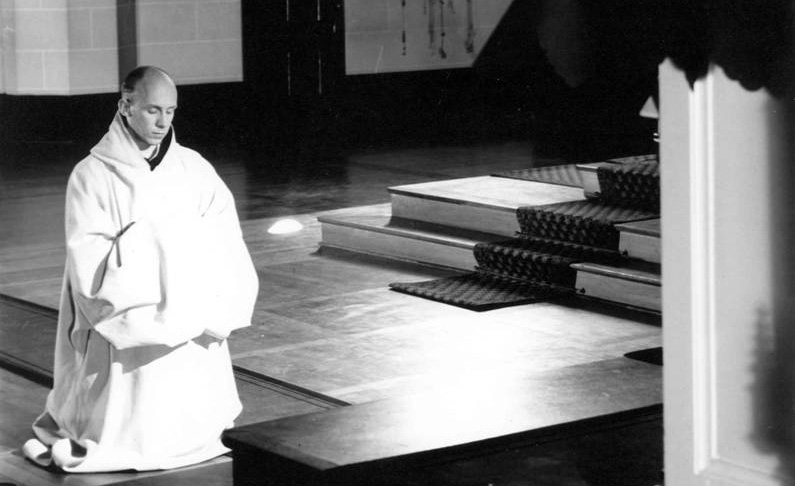
The above is one of my favourite Merton pictures. It is, I think, from the time of his ordination to the priesthood. I wonder how he felt about having his picture taken during prayer? I know how I would feel.
I have been using a “meditation bench” for a time of mental prayer in the morning. I am old and I find sitting, kneeling, or standing somewhat difficult. But I can kneel using the bench. It keeps my back straight so I get little to no ache. Alas, I do not have enough padding so I do get a little sore sitting on the bare bench.
I think about all the things I do during the day. All the things I think are vital. Yet I often cannot find 10 minutes to just rest in the presence of Jesus. I want to organise my day better so that I can start with time with Jesus – resting, listening, lamenting.
Anyway, have a Jesus filled day.
Common Worship
This morning I had a decision: I am going to move to using Common Worship: Daily Prayer exclusively. Not going to change the world, not going to move anyone else! I have used Common Worship with the Australian Lectionary. I have purchased a copy of the lectionary from the Church of England and I will use that lectionary for my divine office.
Yes, not earth-shattering! And most likely very myopic. Yet the rhyme that Common Worship establishes with a four-fold office really suits me. And I am really not sure how I would survive without it – I often say Prayer During the Day in the car at work.
So … nothing happening here, just move on!
Psalm 55
Psalm 55 was part of Morning and Evening Prayer today. This morning I was struck by these verses:
And I said: ‘O that I had wings like a dove, ♦
Psalm 55:7-9
for then would I fly away and be at rest.
‘Then would I flee far away ♦
and make my lodging in the wilderness.
‘I would make haste to escape ♦
from the stormy wind and tempest.’
I often want to escape. I am never sure if I have faith or just a very strong desire to escape. Maybe a better way to put it is that I am not sure whether I have a vocation or a strong desire to escape?!
So I identify with the above verses. Indeed I would like to be a dove that flys into the wilderness and is never heard from again. And that urge is so strong sometimes. But is it the wilderness that I want to escape to? Or is it into Jesus that I want to escape?

