… emotional roller coaster

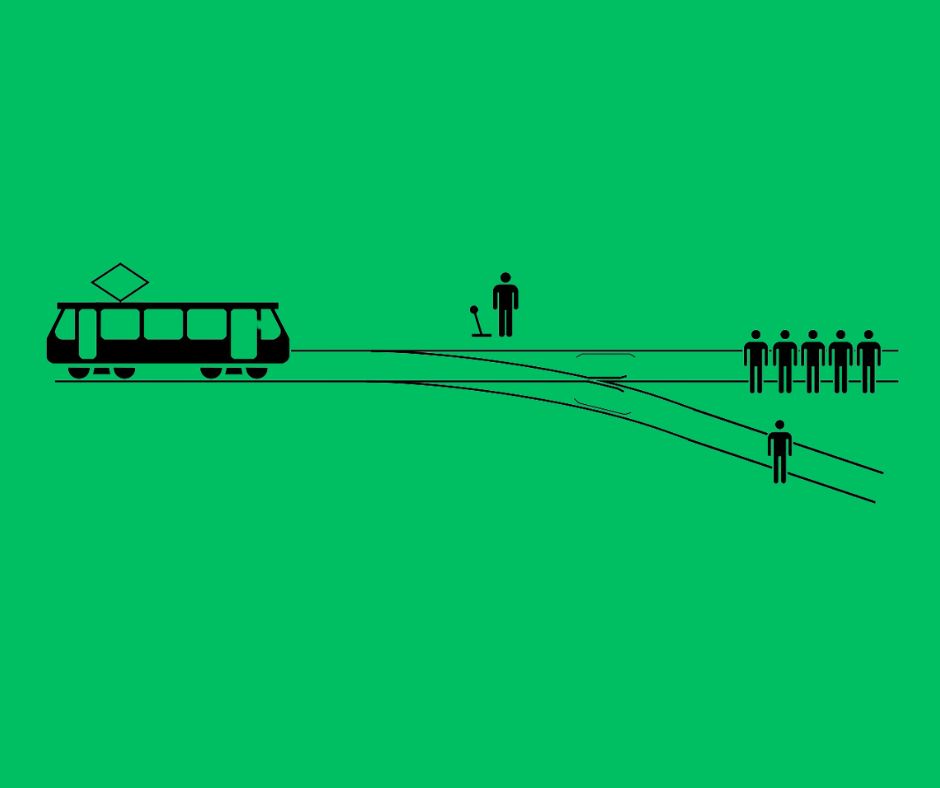
I have been thinking about the trolley problem. It was the first thought experiment I read about when I became interested in philosophy. So, in brief, your only option is to pull the lever or not. Utilitarian ethics would place the greater good at the forefront of mind – one vs five. So the active choice of pulling the lever to kill one is a “better choice” than the passive non-action. For me, the first question is what type of person can make that choice?. Who am I to pull the lever to kill one person over five?

So how would the choice change when the “one person” is more defined? Let’s say the one person can heal more than five? Would that change the choice? Yet my real question is, how would my choice change if I have an emotional relationship with the one? Either positive or negative. Would my relationship change my actions?

To return to the original utilitarian point: is the good defined by my relationship? Is there any objective (external to me) way of defining the good?

Sorry, that was way too heavy!!!!

feelings?

For most of my life, I have heard people say, “Feelings cannot be trusted”. And I must have said it a few times myself. I assume that feelings are subjective and therefore not trustworthy. But “reason” (whatever that may be) can be trusted because it is objective.

Why? Why can I not trust my feelings? Why can I not trust the subjective? In fact, why would I trust the objective? And is there such a thing as objective? Is reason always objective?

Why is only that trustworthy which is outside of me?

Maybe Boethius is to blame? Most likely it is me.

intention?

Intentions are mental states in which the agent commits themselves to a course of action.

Wikipedia

A mental state, or a mental property, is a state of mind of a person.

Wikipedia

So Intentions are decisions and choices within an individual to act – a resolution! By their very nature, these resolutions are not perceivable to the senses – they cannot be measured. So individual’s intention can only be assumed and never known, especially if the person has not communicated their intention.

Just saying …

absurdism

Absurdism is the philosophy that there is no true meaning of life, so humanity’s attempts to find one are, essentially, absurd.

What is aburdism?

Simple yet a good start. Life does not owe me meaning. Why does life need meaning? Why does my life need a purpose? Do I need to know the outcome before I start?

Kierkegaard speaks about it in Fear and Trembling. The single individual’s job is not to conform to the universal or the moral.

skepticism

Skepticism arises from our desire to know without the self being transformed. Ironically skepticism is but the result of our anxious desire to secure certainty by being “at home in the world.”

Harvey. Skepticism, Relativism, and Religious Knowledge

liminal space?

I have been trying to organise some thoughts around the religious life. And I found this quote:

The liminal space is an invitation to surrender – an invitation to give over to something larger than self and trust that we will be held and supported with whatever we need in order to navigate the uncertainty. The degree to which we are comfortable or uncomfortable has to do with how we choose to be with what is happening. We can choose to fight against the liminal space and struggle, or to flow with it by listening, sensing, and responding.

The Liminal Space – Embracing the Mystery and Power of Transition from What Has Been to What Will Be

Maybe the older mystical writers would call it “the cloud of unknowing”? There is a sense in which the religious life, or Christianity as a whole, is a “what if” life. I think the current Archbishop of Canterbury said that?!

feelings?

Sometimes I reflect on the many things that I have heard in sermons throughout the years. For me, that includes some time in seminary.

So, I have been wondering:

Why can I not trust my feelings but I can trust my reasoning?

I cannot recall how many times I have been told that my feelings are untrustworthy but my reasoning I can trust. (And let’s assume that hermeneutics is a form of reasoning.) But how realistic is that? Or, maybe more importantly, how human is that?

Happy to read any answers!

accept to expect

I have been meaning to write this for a couple of days. While having a coffee I was challenged (indirectly) by someone to move from “accept to expect”. And I have been reflecting on that for a couple of days.

I really like that! Not “I accept God will come to my help” but “I expect God to come to my help”. I think there is a sense of action in being “expectant” on God. As the shift from “choice” to “resolution” is a movement toward action, from possibility to actuality, so “accepting” to “expecting” is a movement.

I think, in a way, that is the movement that Kierkegaard expects (!!) in faith. The change from possibility to actuality. The movement from having faith in Jesus to imitating Jesus in my daily life. Maybe that is what the Brethren of the Common Life called “conversion”. From the head to the heart?!

Is that too over the top philosophical?

usefulness?

I have been reading The Handmaid’s Tale and watching the TV version. I am not sure if that is confusing me or making it a little easier.

This morning I thought of Immanuel Kant:

Kant’s formulation of humanity, the second section of the categorical imperative, states that as an end in itself, humans are required never to treat others merely as a means to an end, but always as ends in themselves.

Kanthian ethics

Part of the objectification of people is using them for their usefulness. We rank people according to how they may serve society and we reward those who are more useful and punish those who are not useful. The Handmaids are simply a more extreme example of how we trend people as a means rather than an end.

I feel my uselessness. No skills for the greater good, sickness dragging down and costing society, without purpose or end. I am very forgettable.

No answer or insight! Simply that people are much more than their usefulness.