the crowd is untruth

We are born biological beings but we must become existential individuals by accepting responsibility for our actions. This is an application of Nietzsche’s advice to ‘become what you are’. Many people never do acknowledge such responsibility but rather flee their existential individuality into the comfort of the faceless crowd.

Existentialism: A Very Short Introduction

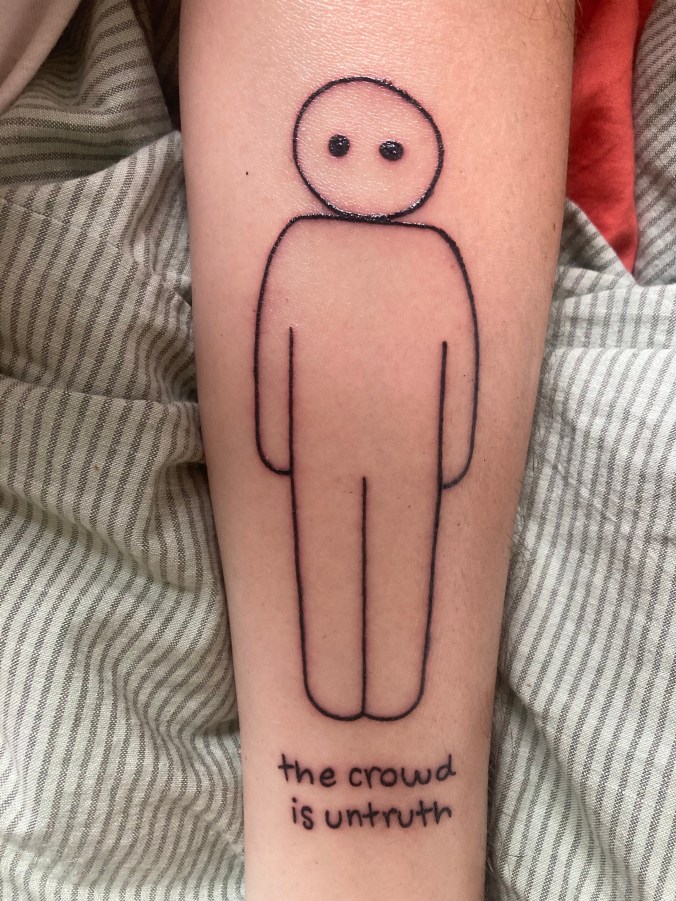
I have a tattoo that says, “the crowd is untruth”. People sometimes see it and think it is an act of rebellion: I can do what I want. (Which is so funny if you know me!) But it is Kierkegaard’s way of summarising the existentialist task we are all called to.

I have been thinking about that distinction: the single individual (Kierkegaard) vs individualism. Individualism is the reason for an action – I can do what I want – while “the single individual” is taking personal responsibility for my actions.

In the context of faith, I am sometimes (often?) intellectually stretched by the idea that what I believe is less important than that I have faith. I have no answer! Apart from saying that the what (or much better the who) is important to me. When the content of faith remains outside of me, do I really have faith? But if the content is only inside of me?

So anyway, feeling cactus so I am escaping into books.
experience

During the week the theme of “experience” has surfaced a couple of times. It reminded me of a thought experiment sometimes called Mary’s Room. I think it highlights the importance of experience. And, by extension, to experience Jesus is better than to know about Jesus.

Also: I think the above is what Kierkegaard writes about in Philosophical Fragments.

Anyway, read the thought experiment and think about it:

Mary is a brilliant scientist who is, for whatever reason, forced to investigate the world from a black and white room via a black and white television monitor. She specializes in the neurophysiology of vision and acquires, let us suppose, all the physical information there is to obtain about what goes on when we see ripe tomatoes, or the sky, and use terms like “red”, “blue”, and so on. She discovers, for example, just which wavelength combinations from the sky stimulate the retina, and exactly how this produces via the central nervous system the contraction of the vocal cords and expulsion of air from the lungs that results in the uttering of the sentence “The sky is blue”. … What will happen when Mary is released from her black and white room or is given a color television monitor? Will she learn anything or not?

chasmic difference

There is, namely, an infinite chasmic difference between God and man, and therefore it became clear in the situation of contemporaneity that to become a Christian (to be transformed into likeness with God) is, humanly speaking, an even greater torment and misery and pain than the greatest human torment, and in addition a crime in the eyes of one’s contemporaries. And so it will always prove to be if becoming a Christian truly comes to mean becoming contemporary with Christ. And if becoming a Christian does not come to mean this, then all this talk about becoming a Christian is futility and fancy and vanity…

Practice in Christianity

I have always liked the above quote from Practice in Christianity. Yes, SK is very Lutheran/Augustinian in it but I think it says something about God: God’s transcendence in being and his imminence in action (in Jesus). It is about the King and the Servant, and love, and surrender.

the moment

I have been thinking for this coming Sunday’s gospel, Luke 13:1-9. Yes, repentance and fruit. But is there something deeper happening? Is it about the eternal now of faith – the moment of choice? That reminded me of one of my favourite SK quotes:

God is present in the moment of choice, not in order to watch but in order to be chosen. Therefore, each person must choose. Terrible is the battle, in a person’s innermost being, between God and the world. The crowning risk involved lies in the pos­session of choice.

Kierkegaard

A number of great themes in the one quote: moment, choice, freedom, risk. All relate to faith. The moment of choice is that overwhelming point where the past is gone and the future is not yet. That moment between penitence and reward. It is the moment, the now, that is completely God’s and in which I must meet Jesus.

I like the image of God’s presence in the moment. Maybe that is contemporality – Jesus present in the moment of choice, ready to be chosen? But the point is: that moment is always the eternal now.

thomas, yes, thomas!

The conclusion of belief is no conclusion but a resolution, and thus doubt is excluded.

Philosophical Fragments

I woke in the night and the above quote came to mind. A little on the weird side, I agree, but it all came together.

I have been reading a book about Thomas a Kempis. In this book, there is a discussion on the origins of the Brethren of the Common Life and, especially, the founder, Geert Groote. Groote wrote “Resolutions and Intentions” which was like a Rule of Life but without any vows. And it was common practice in the Brethren for individuals to write such a document and not take religious vows in the traditional way.

The above now makes even more sense to me. Live life without vows or a Rule but live with a clear resolution. Allow life to be shaped by this resolution but make no show of it or put yourself under vows.

So, in the history of the church, there is a way to live a converted (religious) life as a layperson without entering a monastery.

And, as an aside, I really like SK’s side-step on doubt in the above quote!

where to from here?

Therefore Christ also first and foremost wants to help every human being to become a self, requires this of [them] first and foremost, requires that [they], by repenting, become a self, in order then to draw [them] to himself. He wants to draw the human being to himself, but in order truly to draw [them] to himself he wants to draw [them] only as a free being to himself, that is, through a choice.

Practice in Christianity

I woke in the middle of the night and that quote came to mind. Besides the fact that I dream of Kierkegaard quotes, and talk to him in English in a coffee shop, which is super-weird, I think the above has something very important to say.

What is Jesus all about? Or, to put it another way, what is “salvation”? As I wrote yesterday, it is not about the past or the future. It is a right-now thing. So what is Jesus’ deepest desire for me right now?

Ok, I cannot work out what my deepest desire right now is so I doubt I can of another person. And I would not dare to say what Jesus desires. But if we take Kierkegaard’s quote seriously, and I think we should, it is about becoming a self – it is about becoming me. Yes, I cannot be a self without him! And that is the central proclamation of the community we call the Church. But becoming a self in Jesus involves my freedom and choices.

I am having issues with “me” at the moment. The above gives shape to come of my issues. And it points me back to Jesus. Jesus now for becoming “me”.

now?

In relation to the absolute, there is only one time, the present; for the person who is not contemporary with the absolute, it does not exist at all. And since Christ is the absolute it is easy to see that in relation to him there is only one situation, the situation of contemporaneity; the three, the seven, the fifteen, the seventeen, the eighteen hundred years make no difference at all; they do not change him, but neither do they reveal who he was, for who he is is revealed only to faith.

Practice in Christianity

I have been thinking about some of the monastic rules I have been reading. There is often a strong note of pentitence. And sometimes some talk of reward. The asceticism described in these rules is often in terms of “soul good, body evil” dualism. Or “suffering good because it wins forgiveness”.

Of course, all that is an oversimplification. But I have wondered how to live a rule of life in a monastic way without falling into those traps. Penitence (the past) or reward (the future) are nice but it is about living for Jesus now. The present moment! So it is about balance in the now to be fully open to Jesus.

experience?

To be honest I only know very little about a very small circle. One of the people I have heard about but never read is Karl Barth. The book I have been reading looks at Barth’s thoughts on monasticism. I will admit that reading it makes me glad to be an Anglican! But I was struck by this:

In Barth’s understanding, Tersteegen’s faith grew “not from confession to experience, but from experience to confession,” which is “the way of self-denial”.

Gerhard Terteegen was a pietist who influenced both Barth and Kierkegaard. So the above quote speaks even more to me.

Maybe a more Kierkegaardian way of putting that is to speak about “resolution preceding conclusions”. Theology is a systematic way of looking at the experience of faith – in Scripture and Tradition – and trying to see themes. But it is the experience that establishes the relationship.

All of that made me wonder: can a heretic be saved? Can a Christian who has experienced the love of God in Jesus be a heretic? Or, to put it a completely different way, can “doctrine save”?

So the answer to the question, that was not asked, is I need to read more!

reading

I have had more time to read. I am a little of a shatter-brain reader – when something takes me I like to simply sit and think. (Or pretend to think!) So sometimes I read a huge amount and sometimes only a sentence.

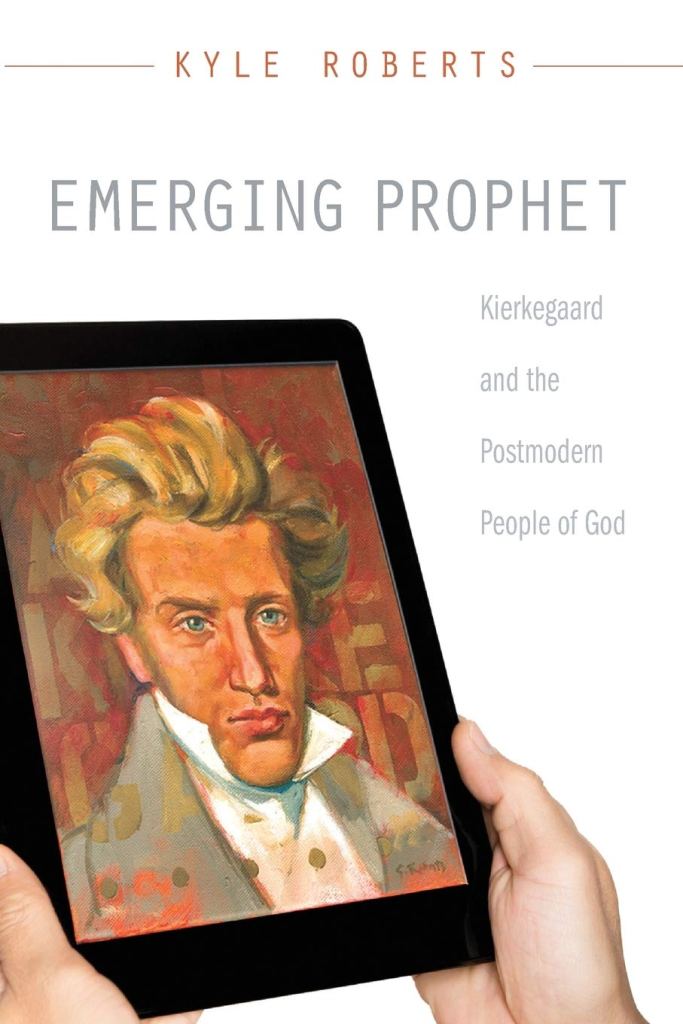
I have been reading Emerging Prophet: Kierkegaard and the Postmodern People of God. I have not read much about the emerging church movement so the book has been a nice introduction. I am more of a new monasticism type person.

I am struck, again, how Kierkegaard is way ahead of his day. He is one of a kind, a single individual, far apart from the crowd. Maybe he is the original new monastic religious? I would like to read more about the emerging church movement! And I want to read more about and by Kierkegaard.

As an aside (completely off-topic): I wonder what Kierkegaard would make of me? (How egotistic!) Would he sit with me in a cafe and drink coffee (and smoke cigars)? Or would he walk past me in the street?

So what are you reading?

… and followed him

This Sunday’s gospel reading, Luke 5:1-11, is about two topics: risk and discipleship. The reading moves from a crowd listening to an individual responding. It takes us from the risk of faith to the call of Jesus to follow Him. So two Kierkegaard quotes:

Without risk, no faith. Faith is just this, the contradiction between the infinite passion of inwardness and objective uncertainty. If I can grasp God objectively, then I do not have faith, but just because I cannot do this, I must have faith. If I wish to stay in my faith, I must take constant care to keep hold of the objective uncertainty, to be ‘on the 70,000 fathoms deep’ but still have faith.

And …

The difference between an admirer and a follower still remains, no matter where you are. The admirer never makes any true sacrifices. [They] always plays it safe. Though in words, phrases, songs, [they are] inexhaustible about how highly [they] prizes Christ, [they] renounce nothing, give up nothing, will not reconstruct [their] life, will not be what [they] admire, and will not let [their] life express what it is [they] supposedly admire.