knowing

The only way of coming to know and understand the divine, therefore, is by the god annulling the absolute difference in absolute equality in the absolute paradox of the incarnation.

Sylvia Walsh. Kierkegaard: Thinking Christianly in an Existential Mode (Christian Theology in Context)

I want to collect quotes that help me work towards a definition of a disciple and the discipleship pathway. I am deeply indebted to Kierkegaard for my major understandings in this area so I am looking for quotes from him. I guess I should start with Scripture, the New Testament, and Jesus.

So the above shows how God takes the first step in the Jesus-event, especially the incarnation. And there is an absolute difference between God and me that can only be bridged in Jesus.

More to think about!

sin – part 2

No, the test in which this woman is tried is: to love her Saviour more than her sin.

Kierkegaard, Søren. Discourses at the Communion on Fridays, 114

I like SK’s Communion Discourses. They are good spiritual reading. He mixes his various geners into these “talks”.

I have been thinking about the above quote from a discourse on Luke 7:47, “Therefore, I tell you, her sins, which were many, have been forgiven; hence she has shown great love. But the one to whom little is forgiven, loves little”. I will leave the quote for you to meditate on.

sin?

… when [the Advocate] comes, he will prove the world wrong about sin and righteousness and judgment: about sin, because they do not believe in me; about righteousness, because I am going to the Father and you will see me no longer; about judgment, because the ruler of this world has been condemned.

John 16:8-11

The Holy Spirit will “prove the world wrong about sin, because they do not believe in me”. Kierkegaard would point out that sin here is the opposite of faith. I would dare to say that sin and faith are two sides of one coin we call “relationship”. One side is a relationship with Jesus we call faith, the other is a broken relationship with Jesus we call sin. Both express themselves in action but that is only a symptom: the relationship is the real issue. So sin is more about being outside of Jesus than having something missing within.

In the mission of the church, in the proclamation of Jesus, the way the individual sees “sin” is central – only thing more important is what the individual says about Jesus. I think we sometimes fall into an idea of sin that is too much like a law-court and too focused on actions. The reality is that the actions follow the relationship and everything done apart from Jesus is sin – even a great good.

I have to acknowledge that I live with both in my life. I try to have a relationship with Jesus but often my brokenness and distance from Jesus shows itself in my actions. And when I am honest about that tension in my life I am always driven back to Jesus as my Saviour.

SK!!

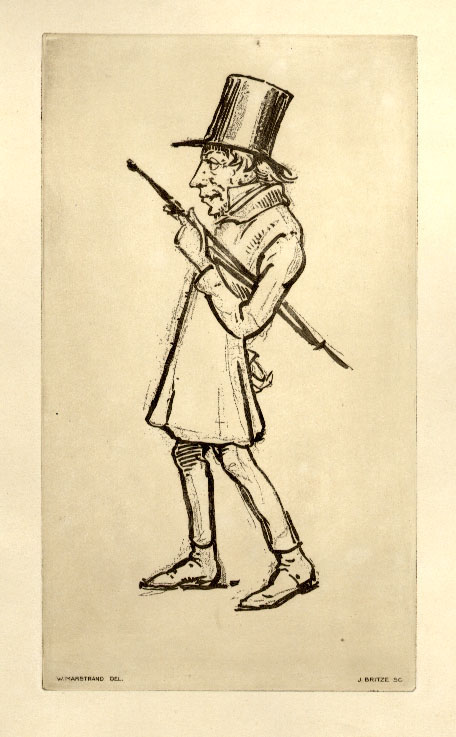
I wanted to share this picture of Søren Kierkegaard, my all time favourite:

Marstrand’s drawing from 1870

It is by Wilhelm Marstrand (1810-73).

“The same evening that the news of Kierkegaard’s death spread through Copenhagen, out at the poet Johannes Fibiger’s, where he chanced to be, Marstrand made a number of loosely sketched ink drawings of Kierkegaard, from memory – one of his specialities!”

P.A. Rosenberg

Now the dates do not match up but it is a great drawing and it exemplifies how I see Kierkegaard.

was SK a charismatic?

My Vicar shared this article with me (and I have been meaning to comment on it). Now remember, I am no theologian or philosopher – only an amateur enthusiast :

5 REASONS CHARISMATIC CHURCHES ARE GROWING (AND ATTRACTIONAL CHURCHES ARE PAST PEAK)

Read the whole article with an open mind. I think it makes some important points. However, as always, I think that most of the points are made by Kierkegaard some 200 years ago. Not as directly as the article but I think that a Kierkegaardian approach (what a horrible term) to Christianity (as against Christendom) would reach the same conclusions.

So… let me just put a few things out there. I think that the modern “charismatic movement” is a form of pietism which, in turn, is a protestant form of Catholic mysticism, which is a form of Desert Spirituality. I think that two points from the article are worth considering:

PEOPLE WANT TRANSFORMATION, NOT INFORMATION

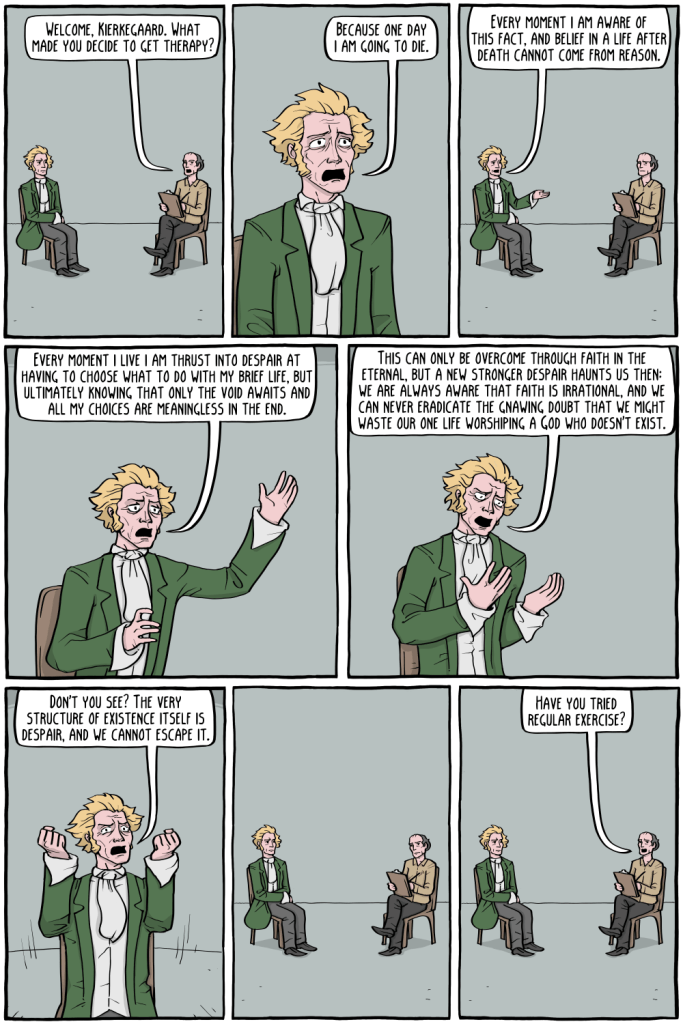
Wow, could there possibly be a more Kierkegaardian idea. Kierkegaardian scholars would call it the “leap into faith” – passion for uncertainty that changes me. The article goes on to speak about “passion” over “polish” – yes, and yes!

TRANSCENDENT IS CONNECTING MORE THAN IMMANENT RIGHT NOW

Now here is my real point. I think that transcendence is the modern way to experience God. But transcendence assumes a “gap”. Whatever we call that “gap”, the individual needs to become aware of it first. Modern people seem to relate better to the completely “Other”.

So, here is a question that I have often considered: if Søren Kierkegaard were around today, would he be a “charismatic”? Maybe not the hands-in-the-air type but a person who values an experience of God over information about God?

Read the whole article and comment below!
Kierkegaard’s gospel?

I have stumbled across this article a couple of times and I feel I may have mentioned it already. So I am linking to it again and just going to quote a paragraph:

There is a scandalous dimension to the intrusion of God upon goodness. Many atheists today claim that Christianity is “offensive” in some way or another. Kierkegaard would say this is quite in order – Christianity is offensive and must be so in order to remain what it is. The offensive aspect of the difference God makes to goodness is one that Kierkegaard thought Socrates missed, as he believed anyone without the benefit of revelation would have done, no matter how wise they were in other respects.

The gospel according to Kierkegaard: Sin, guilt and the offense of forgiveness

Christianity is offensive because there is something offensive about Jesus. When an individual is confronted by the reality of the Word Incarnate, the God-man, offence is one of the responses – the other being a leap into faith, into the uncertainty of a relationship. The same as when the individual is confronted by the reality of sin in their own life. Modern Christianity has turned Jesus into one product amongst many and has made Him acceptable to the market. But do I miss the real depth of the Gospel when I refuse the offence of Jesus?

Another paragraph:

To forgive sins is a radical, wild, gratuitous folly. Really to forgive is to do something grossly offensive: it is to move beyond the categories of moral good and evil, to declare that, yes, an evil has been done against you, but that the evil is dispelled, it is of no account. Forgiving sin however means that the forgiver is still exposed to the possibility that the offender could hurt them again. This is part of what makes forgiveness so reckless: it offers no protection against future injury. For someone really to forgive, they have to reconcile themselves to the offenses of the past and remain vulnerable to injury in the future. Most of us are too self-protective, too shrewd, too timid really to forgive. But without forgiveness we are stuck in a cycle of self-loathing and despair.

I really like that paragraph. There is something very offensive about forgiveness. Because there is a risk of future injury. Forgiveness is a willingness to remain in a relationship even if the future is full of risk. All because of the other person, because of love. Anyway, I like the above article and it is Australian so another bonus.

single individual

The paradox of faith then is this, that the single individual is higher than the universal, that the single individual, to recall a now rather rare theological distinction, determines his relation to the universal by his relation to the absolute, not his relation to the absolute

Kierkegaard: Fear and Trembling (Cambridge Texts in the History of Philosophy), 61.

I find this a very interesting part of Fear and Trembling. I think this is what Kierkegaard means by “faith” – the distinction between the single individual and the universal, and the relationship between the single individual and the absolute. And I think people’s misunderstanding of him, and his thought, comes from a misunderstanding of this distinction and relationship.

First to make it clear: I do not think that Kierkegaard is anti-community. Kierkegaard writes for the single individual and not for a theological school or ecclesial tradition. In some ways, his writing is closer to spirituality than theology or philosophy. He is speaking of the relationship between the individual and God, not between two or more individuals. Community is part of God’s good creation but it is not the goal of the individual’s life. The goal is a relationship with the “absolute” – to transcend the here and now. And it is this transcending relationship that must proceed any other relationship.

Belonging to a Christian community is very different to belonging to Jesus. Or, as I once read Kierkegaard saying, “being in the parish register is not the same as being in the Book of Life”. Yes, I need other people! And I have really learned what that means in the last three months. But I need Jesus more. And my relationship with Jesus gives context to my relationship with others, and not vice versa.

Anyway, I like the above quote!